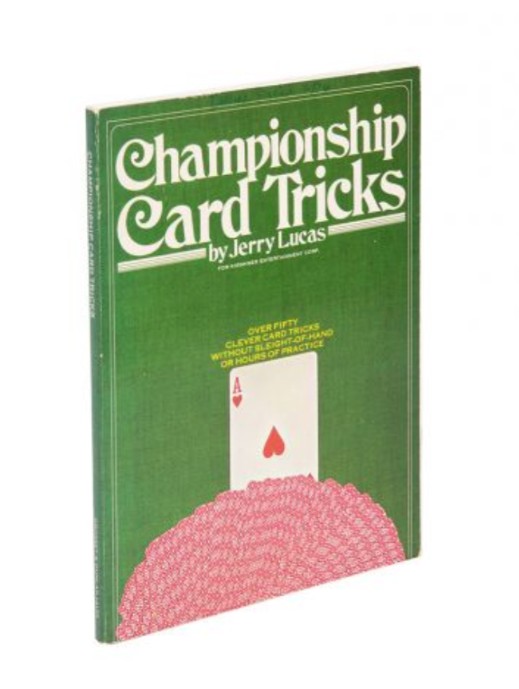
CONTENTS INTRODUCTION _____ 1 HOW TO COVER UP A MISTAKE _____ 3 1. The Mystery of the Tenth Card _____ 5 2. Four Predictions _____ 6 3. Three for the Countdown _____ 8 4. Four for the Countdown _____ 10 5. Quickie Prediction _____ 11 6. Super-Quickie Prediction _____ 12 7. “I’ve Got Your Number” _____13 8. Cards Will Tell _____ 14 9. Right—and Right Again! _____ 16 10. “Jerry Lucas Tricked Me” _____ 17 11. A Magic Spell _____ 19 12. The Dragon Prediction _____ 20 13. Kings Rule the Cards _____ 22 14. Magic Hands _____ 24 15. The Amazing Card Reverse _____ 25 16. Find It Yourself _____ 28 17. The Tuned Ear _____ 29 18. Peek At a Card _____ 31 19. A Simple Location _____ 32 20. Another Simple Location _____ 33 21. The Cards Know _____ 34 22. A Mystifying Card System _____ 35 23. Mind Control _____ 38 24. Moving Numbers _____ 40 25. Four-Card Finder _____ 4] 26. “Hello, Hawkeye!” _____ 42 27. Sensitivity! _____ 44 28. The Magical Match _____ 45 29. The Unified Cards _____ 46 30. Do As I Do _____ 46 31. "Oops, I’m Sorry" _____ 47 32. A Card and a Number _____ 48 33. "That's It!" _____ 50 34. My Favorite Ace Trick _____ 52 35. "Lucky l3" _____ 53 36. Nine Is the Number _____ 54 37. Elimination _____ 55 38. A Choice Prediction _____ 56 39. Crosscut _____ 58 40. Magic Square Count _____ 59 41. Seven Down _____ 60 42. Mental Slip _____ 62 43. Impossible Location _____ 63 44. Four Pile Location _____ 64 45. "Concentrate, Please!" _____ 65 46. Inner Spirit _____ 66 47. Dots All _____ 68 48. Hearts Will Tell _____ 69 49. You Help Me _____ 70 50. Color Blind _____ 72 51. The ““No-Card Card Trick” _____ 73 52. Talking Cards _____ 74 53. "Allow Me One Error" _____ 76 54. Pocket Pull _____ 77 55. Jackelope _____ 79 56. Cards in Wallet _____ 80 —– INTRODUCTION Card magic is fun for everyone. It has brought pleasure to performer and audiences alike for hundreds of years. Until recently, in card-magic history, it often required years of diligent practice to develop sleight-of-hand and manipulative abilities to present a good variety of card tricks. This book will enable those untrained in card magic to demonstrate amazing effects of a seemingly endless variety in a short amount of time without mastering difficult sleight-of-hand techniques.Even though these tricks can be accomplished without the use of any sleight-of-hand, they should be understood and practiced thoroughly before attempting to show them to anyone. Don’t become so thrilled when you have gone through a trick for your Own amazement that you must rush right out to display your new talent. Patience in magic is a virtue. First review each trick and its presentation again and again until you are familiar with its working without the slightest hesitation or thought. Then try the effect on family members or a close friend before you try it in front of a strange audience. Ask for criticism without explaining how the trick works! Others may see mistakes you aren’t aware of. There is nothing more embarrassing in magic than making a mistake. Mistakes sometimes can be covered up, or at times even turned to possible advantage (that will be discussed later), but the best insurance is to practice enough so that mistakes will not be made. Once you have mastered some tricks, your first inclination may be to perform everything you know at every performance. Don’t do this! Always leave an audience wanting more. Never, and I mean never, repeat the same trick to the same audience. This is especially true for a new card magician. After becoming more proficient, you may feel that one or two card tricks may even work better the second time around, but it’s best not to try to repeat. And also, never reveal how a trick works. Don’t even teach the audience one of your easiest tricks, because it may be so basically simple that it will take some of the glitter away from your Other tricks. Many times, what you say during the performance of a trick can be more important than the trick itself.A trick is something like a novel or story. It has a beginning, a plot, and an ending. I have included a little story to go with most of the tricks in this book. Learn the story, as well as the working of the trick, and rehearse the way you will tell it. One is no good without the other. Talk (or "patter," as it’s called by magicians) will also develop your confidence and many times allow you to divert an audience’s attention from something you don’t want them to see. You should also develop several presentations for use at different occasions or for different audiences. Plan a presentation that has variety, avoid more than one trick that may have a similar effect, and predetermine an approximate time limit. After a schedule has been developed, follow it exactly during your performance. It will boost your confidence and your program. Until you become more proficient, you might even want to consult a sheet that has your tricks listed in sequence. The names of the tricks won’t mean anything to your audience, but the schedule could make your program seem professional. Now get a deck of cards and enjoy yourself. By the time you finish this book and become familiar with all of the principles, I’m sure you will invent several card tricks of your own! Jerry Lucas